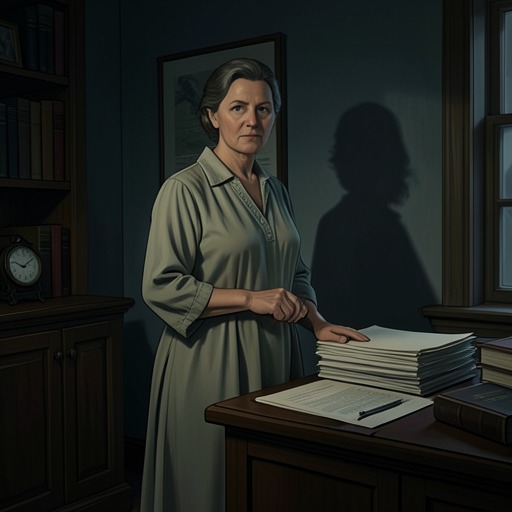
Hannah Hall
The Last Thing He Told MeHannah Hall’s defining crisis is not simply that Owen Michaels disappears, but that his disappearance makes her question whether the marriage and family life she believed she knew were built on a false identity. A New York woodturner who becomes Owen’s wife and Bailey’s stepmother, Hannah moves from reading people through careful observation to acting on behalf of a frightened child. Her arc turns on a practical distinction she learns too late to take for granted: trust is not established by being pleasant, but by showing up when it is difficult.
Identity and Background
Before meeting Owen, Hannah had lived in New York City for thirty-eight years and kept her own surname after they married. She has been Owen’s wife for a little over a year, but she does not automatically correct people who call her Mrs. Michaels. The title is less a statement about her legal name than a question about her connection to Owen: what others want to know is whether she is his wife. Her hesitation captures a divided sense of belonging. She is Hannah Hall, and she is also someone whose public identity has become legible through her marriage.
Hannah met Owen a little over two years earlier, while she was still living in New York City. Her work is woodturning: she describes it as sculpting wood rather than shaping clay. Her workshop and showroom occupied a small, expensive storefront on Greene Street in SoHo, a life and working environment sharply unlike Sausalito, the quiet Northern California town where Owen and Bailey had lived for more than a decade and which Hannah came to call home. The move joins her life to theirs without erasing the former one; she remains someone with a trade, a former city, and a name she chose not to surrender.
Marriage and Family Tensions
Hannah’s entry into Owen’s family is uneasy from the beginning. Bailey is sixteen, guarded, and difficult for Hannah to reach. On first meeting her, Hannah mistakenly says she looks younger than she is; then, trying to repair the offense, she jokes that she wishes someone would make her look younger. Bailey barely tolerates her afterward. Hannah recognizes that the mistake was not just the joke itself but her assumption that conversational charm could bridge the distance. She learns to stop trying to talk too much, though the early estrangement remains an important measure of how much her later care for Bailey has to be earned.
The disappearance makes that strained stepmother–stepdaughter relationship newly urgent. At one point Hannah is in a hotel hallway, eight floors above an atrium where conference guests, restaurant couples, and tired parents appear, from a distance, to be living ordinary lives. She envies them for a moment, then acknowledges that appearances reveal little about anyone else. What she does know is that her own marriage and life feel like a lie. She recalls that, only three days earlier, she would have said she knew everything important about Owen. The revelation that his basic identity may be uncertain overturns the confidence she had placed in her ability to notice details.
Owen’s Disappearance and Hannah’s Investigation
Owen leaves for work and does not return as expected. At eight that evening, Hannah is waiting by the front exit of Bailey’s school and trying his phone again. It goes straight to voicemail. He has been gone for twelve hours; two hours have passed since the visit from the soccer-uniformed girl; and Hannah has already left eighteen messages. The concrete accumulation of calls and waiting gives the absence its immediate scale: this is not yet an explanation, only a silence that keeps lengthening.
Owen’s note offers a brief instruction rather than an account: “Protect her.” Hannah is left alone with the note and a kitchen full of burnt pasta, an ordinary domestic scene made strange by the fact that the person who might explain it is unreachable. She does not know what the instruction means, but it directs her attention toward Bailey and becomes a recurring test of what she should do next.
After Grady Bradford tells her that Owen is not who she thinks he is and leaves, Hannah returns to the house to retrieve Owen’s laptop. She doubts the reassuring version of Grady she has known: perhaps he has been following Owen closely, as he appears to have followed Avett Thompson, and perhaps his help with Bailey’s custody was a way to prompt her to reveal information. These are suspicions, not established facts. Their effect, however, is decisive. Hannah resolves not to risk further disclosure to Grady or anyone else until she can understand what is happening with Owen.
In Austin, Hannah uses a phone with a shattered screen to send Jake a detailed lead: Katherine “Kate” Smith’s maiden name, Kate’s brother Charlie Smith, Austin, and the possibility of a daughter named Kristin who would match Bailey’s age. She asks Jake to check for a birth, marriage, and death certificate. The message records a working hypothesis and a request for verification, not a solved identity. Hannah knows the phone can help Owen find them, but can also expose them to other people; she intends to destroy it and leave Austin, fearing Charlie and whoever may be with him. Even while trying to disconnect from surveillance, she struggles to remember what further clue she should be looking for.
Care, Choice, and Narrative Role
Hannah’s changing understanding of care comes into focus when Bailey questions whether her own name and identity were changed too. Hannah sees Bailey’s vulnerability and recognizes that simply being nice has not taught her stepdaughter that she can rely on her. Dependability, Hannah realizes, is learned in the moments when people are too exhausted to perform sweetness and must show what they will actually do. Drawing on what her grandfather did for her, she decides to do whatever is necessary to make Bailey feel safe. The shift is from managing an impression to accepting responsibility for another person’s security.
That responsibility shapes Hannah’s actions even when she believes she is returning to danger. She leaves Owen’s note beneath a phone on a conference-room table for Grady to find, preserving its instruction for him rather than carrying it away without explanation. Then she walks quickly through unfamiliar Austin streets to be with Bailey, though she understands that this takes her back to the place she is not supposed to go. The note’s two words thus become more than a mystery about Owen’s intentions: Hannah makes them a standard for her own conduct.
Hannah’s first-person account makes the investigation inseparable from the instability of knowing another person. She has long prided herself on noticing small details, a disposition she connects to her mother’s departure; now that confidence fails at the scale that matters most. Her knowledge of Owen is simultaneously intimate and incomplete. Against that failure, the narrative places observable acts: the unanswered calls, the laptop retrieved, the names sent for checking, the broken phone, and the walk back toward Bailey. Hannah’s significance lies in this movement from interpreting Owen to choosing what Bailey needs, even while the truth about Owen remains unresolved in the evidence presented here.